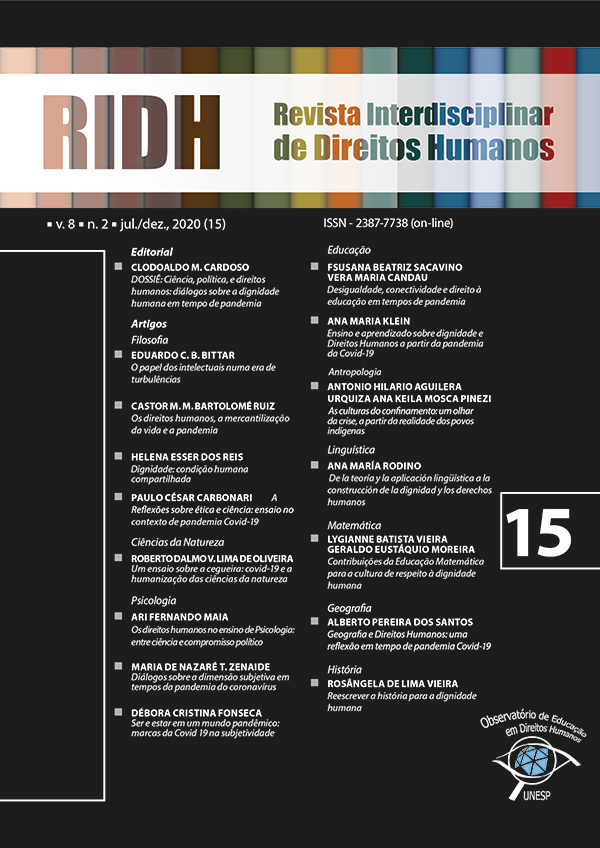
Dignidade: condição humana compartilhada
DOI:
https://doi.org/10.5016/ridh.v8i2.9Palabras clave:
Indivíduo, Singularidade, Individualismo, Solidariedade, Dignidade HumanaResumen
O presente artigo visa discutir avanços e recuos no processo histórico de construção da ideia de dignidade humana, a fim de contribuir com o dossiê “Ciência e política: diálogos sobre a dignidade humana em tempo de pandemia”. Nossa abordagem será filosófica e partirá da concepção de dignidade humana como valor da pessoa. Com base no pensamento jusnauralista moderno, investigaremos o indivíduo livre e igual do estado de natureza buscando compreender a tensão entre singularidade e individualismo que, embora presente nesta na concepção de indivíduo, aprofunda-se no séc. XIX. Discutiremos, então, a relação com o outro (indivíduo e comunidade) a fim de evidenciar que a aniquilação de vínculos comuns tende a conduzir as pessoas a condições sociais e políticas de subordinação e opressão. O problema que se põe, então, a ser investigado é o reestabelecimento dos vínculos. Rousseau e Tocqueville encontram na empatia em vista do sofrimento da outra pessoa o caminho contraporem-se à corrosão dos vínculos. O respeito à dignidade humana como uma condição compartilhada emerge junto com a solidariedade.
Dignity: shared human condition
This article aims to discuss the advances and retreats in the historical process of building the idea of human dignity, in order to contribute with the dossier “Science and politics: dialogues on human dignity in pandemic times”. We will use a philosophical approach that starts in the idea of human dignity as one’s value. Based on the modern jusnaturalism thinking, we will investigate the state of nature of the free and equal individual, pursuing to understand the tension between singularity and individualism that, although is present in the idea of the individual, deepens in the 19th century. Then, we will discuss the relationship with the other (individual and community) in order to show that the annihilation of common attachments tends to drive people to social and political conditions of subordination and oppression. So, the problem that is being investigated is the reestablishment of attachments. Rousseau and Tocqueville find in the empathy towards the suffering of the other the path, opposing to the extinction of the attachments. The respect to human dignity as a shared condition emerges together with solidarity.
Keywords: Individual. Singularity. Individualism. Solidarity. Human dignity.
Descargas
Referencias
COMPARATO, Fábio Konder. Ética: direito, moral e religião no mundo moderno. São Paulo, Cia das Letras, 2006.
CONSTANT, Benjamin. Da liberdade dos antigos comparada a dos modernos. In: MORAES, João Quartim (org.). Filosofia política. Porto Alegre, LPM, 1985.
DECLARAÇÃO DOS DIRETOS DO HOMEM E DO CIDADÃO. Paris, 1789. Disponível em: http://www.direitoshumanos.usp.br/index.php/Documentos-anteriores-%C3%A0-cria%C3%A7%C3%A3o-da-Sociedade-das-Na%C3%A7%C3%B5es-at%C3%A9-1919/declaracao-de-direitos-do-homem-e-do-cidadao-1789.html. Acesso em: 15 ago. 2020.
DECLARAÇÃO UNIVERSAL DOS DIREITOS HUMANOS, ONU, 1948. Disponível em: http://www.direitoshumanos.usp.br/index.php/Table/Sistema-Global.-Declara%C3%A7%C3%B5es-e-Tratados-Internacionais-de-Prote%C3%A7%C3%A3o/. Acesso em: 15 ago. 2020.
DOUZINAS, Costas. O fim dos direitos humanos. São Leopoldo, UNISINOS, 2009.
HOBBES, Thomas. Leviatã. São Paulo. Abril Cultural, 1979. Coleção Os Pensadores.
HOBBES, Thomas. Do cidadão. São Paulo: Martins Fontes, 1992.
KANT, I. Fundamentação da Metafísica dos Costumes. São Paulo. Abril Cultural, 1980. Coleção Os Pensadores.
LAMBERTI. Jean-Claude. La notion d’ invidualisme chez Tocqueville. Paris, PUF, 1970.
LOCKE, John. Segundo tratado sobre o governo. São Paulo. Abril Cultural, 1978. Coleção Os Pensadores.
GOLDSCHMIDT, Victor. Antropologie et politique. Les principes du système de Rousseau. Paris: Vrin, 1983.
PACTO INTERNACIONAL DE DIREITOS CIVIS E POLITICOS, ONU, 1966. Dispónível em: http://www.direitoshumanos.usp.br/index.php/Table/Sistema-Global.-Declara%C3%A7%C3%B5es-e-Tratados-Internacionais-de-Prote%C3%A7%C3%A3o/. Acesso em: 15 ago. 2020.
PACTO INTERNACIONAL DE DIREITOS ECONÔMICOS, SOCIAIS E CULTURAIS. ONU, 1966. Dispónível em: http://www.direitoshumanos.usp.br/index.php/Table/Sistema-Global.-Declara%C3%A7%C3%B5es-e-Tratados-Internacionais-de-Prote%C3%A7%C3%A3o/. Acesso em: 15 ago. 2020.
ROUSSEAU, Jean-Jacques. Emílio. São Paulo: Martins Fontes, 1999.
ROUSSEAU, Jean-Jacques. Do contrato social. São Paulo. Abril Cultural, 1978. Coleção Os Pensadores.
RUIZ, Castor Bartolomé. As encruzilhadas do humanismo. A subjetividade e a alteridade ante os dilemas do poder ético. Petrópolis, Vozes, 2006.
TOCQUEVILLE, Alexis de. A democracia na América. Belo Horizonte, Itatiaia – EDUSP, 1977.
TOCQUEVILLE, Alexis de. O antigo regime e a revolução. São Paulo, Martins Fontes, 2009.
Descargas
Publicado
Número
Sección
Licencia
Derechos de autor 2021 Helena Esser dos Reis

Esta obra está bajo una licencia internacional Creative Commons Atribución-SinDerivadas 4.0.
Autores mantêm os direitos autorais e concedem à revista o direito de primeira publicação, com o trabalho simultaneamente licenciado sob a Creative Commons Attribution License que, permitindo o compartilhamento do trabalho com reconhecimento da autoria do trabalho e publicação inicial nesta revista.
Autores têm autorização para assumir contratos adicionais separadamente, para distribuição não-exclusiva da versão do trabalho publicada nesta revista (ex.: publicar em repositório institucional ou como capítulo de livro), com reconhecimento de autoria e publicação inicial nesta revista.

 Revista Interdisciplinar de Direitos Humanos